
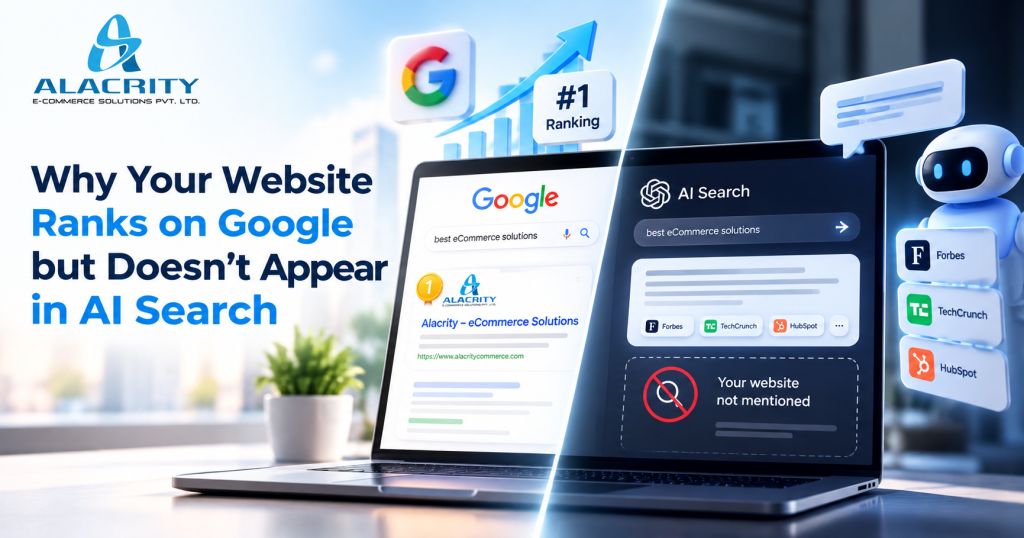
Ranking well on Google does not automatically give your website visibility in AI search. An AI-generated answer may address a different question, draw on several sources or select another page to support a specific explanation.
For B2B businesses, this matters when potential customers research problems and compare providers. A strong keyword report may not show whether your company appears during those conversations.
Start by understanding the gap. Check which questions you are missing from, whether the relevant platform can access your content and how well your pages answer buyers’ needs. No website change can guarantee an AI citation.
Understand Why Rankings and AI Citations Differ
A Google ranking reflects a page’s position for a search. An AI citation means a source was selected to support information in an answer.
Google explains that AI Overviews and AI Mode may use query fan-out, running related searches to explore different parts of a question. Their answers and supporting links can differ.
For example, a consultancy might rank for “ERP integration services.” A buyer asking how to connect an older ERP to an online store without disrupting orders needs more specific information.
A broad service page may leave that question unanswered. This suggests a content gap to investigate, although it does not establish why another source was selected.
Check Access Before Creating More Content
A website accessible to Google may have different restrictions for other search crawlers.
OpenAI’s crawler documentation distinguishes OAI-SearchBot, used for ChatGPT search, from GPTBot, used for potential model training. Their controls are independent. Allowing search access does not require allowing training access.
Ask your developer to review robots.txt rules, firewall challenges and failed requests affecting important public pages. Confirm that the main content is retrievable and that restrictions are intentional.
Make targeted changes after identifying the problem. Opening access enables discovery, but it does not secure inclusion in an answer.
Compare Your Pages With Actual Buyer Questions
Review questions from sales calls, enquiries and project discussions. These provide a practical starting point for identifying missing information.
A prospect evaluating e-commerce development may want to understand platform limitations, integration requirements and post-launch responsibilities. A page listing services without explaining these details may offer little help with the decision.
Compare each important question with your existing content. Improve the relevant page before commissioning a separate article that repeats it.
This is a recommendation for making content more useful to buyers. It should not be presented as a proven formula for earning AI citations.
Explain the Work Behind Your Services
Describe what your service includes, what the customer must provide and which conditions affect delivery.
For a hypothetical website migration, useful details could include product-data checks, redirect planning, integration testing and launch approvals. Confirm the process with your delivery team before publishing it.
Place the direct answer near the relevant heading, followed by the necessary explanation. Readers should be able to find a basic requirement without working through several paragraphs of promotional language.
Keep limitations visible. Clear information about exclusions and responsibilities helps buyers judge whether your offering fits their project.
Publish Evidence Worth Referencing
Google wants content that’s original and helpful. It should give a point of view instead of just copying what is already out there.
Think about what your team can prove: a step by step process that is written down a project that has been approved or a comparison that shows differences, between options.
Case studies need context. Explain the starting situation, work completed, measurement period and limitations. If several changes contributed to a result, acknowledge them.
Use real contributors and reviewers where appropriate. Their roles should reflect their involvement and relevant knowledge.
Illustrative examples are useful too, provided they are clearly labelled and do not include invented customer outcomes.
Keep Business Information Clear and Consistent
Review how your website describes your services, customer markets and delivery arrangements.
A US retailer considering an overseas development partner may need to know when the teams can meet and who handles urgent issues. “Serving global clients” does not answer those questions.
Distinguish a physical office from a region where you accept customers. Publish only support arrangements and capabilities the business can deliver.
Correct outdated descriptions across profiles you control and request corrections to inaccurate third-party listings. This helps buyers assess your company, without guaranteeing that a platform will recommend it.
Maintain the SEO Foundation
Keep technical SEO within routine website maintenance. Review indexing, useful internal links and whether important information is available in accessible text.
For Google, its current documentation identifies indexing, snippet eligibility and the Search generative AI inclusion control in Search Console as eligibility considerations. Meeting requirements still does not guarantee appearance.
Google’s generative AI optimization guide also says special AI markup and llms.txt files are not required for its search features.
Before approving a new tactic, ask which platform it applies to and what evidence supports it. Preserve useful pages while addressing confirmed problems.
Measure AI Visibility Carefully
Separate brand mentions, source citations and provider recommendations. They represent different outcomes and should not be combined into one success measure.
Build a small set of realistic buyer questions. Record the exact prompt, platform, date, market and cited URLs, including whether web search was used.
Google announced dedicated Search Generative AI performance reports in June 2026 and states that the insights were available worldwide by August 31, 2026. Review the reporting in your Search Console property.
Assess identifiable referral visits and enquiry quality separately. A citation does not establish revenue impact, and an answer that produces no visit will not appear as referral traffic.
Follow a Practical Improvement Process
Start by setting a baseline before making any changes, to the website. This helps you understand the current performance and measure progress accurately. Save representative answers and note missing mentions, inaccurate descriptions and cited competitors.
Resolve confirmed access problems first. Then improve a manageable group of commercially important pages using verified service information and evidence.
Keep a change log showing what was updated and when. Repeat the same checks periodically instead of replacing difficult prompts with easier ones.
There is no dependable deadline for citations. Evaluate patterns and business outcomes, while acknowledging that changes in platform behaviour may also affect results.
How Alacrity Can Support This Work
At Alacrity E-Commerce Solutions, our published services include digital marketing and SEO, website design, and e-commerce development. These address several foundations relevant to a website and content review.
The appropriate scope depends on your website’s condition and business priorities. Review Alacrity’s services when defining the pages to assess, implementation responsibilities and reporting needs.
An agency can commit to agreed deliverables, such as technical findings or revised content. It cannot guarantee an independent platform’s future citation decisions.
Conclusion
Improving visibility in AI search starts with understanding where your website is missing and what evidence supports a change. Check access, answer important buying questions and measure results consistently. Contact Alacrity to talk about how this work might fit your SEO and website goals.
FAQ‘s
Does a first-page Google ranking guarantee an AI citation?
No. AI answers may explore related questions and select different supporting sources. A ranking for one keyword does not establish inclusion in every relevant answer.
Should I replace SEO with AEO or GEO?
Keep SEO as the foundation. AEO and GEO can describe work focused on AI answers, but recommendations should still be checked against platform guidance.
Does allowing OAI-SearchBot guarantee ChatGPT visibility?
No. It supports access for ChatGPT search. Access alone does not guarantee that your page will be selected or cited.
Should I rewrite every page for AI search?
Start with pages where you have identified a specific problem or information gap. Preserve content that already helps customers and supports your business goals.
How long does improving AI visibility take?
There is no reliable universal timeframe. Establish a baseline, document changes and monitor patterns without promising a deadline for mentions or leads.
Tagged AI search visibility, Google ranking, AI search optimization, ChatGPT visibility, AI citations, generative search, SEO, AEO, GEO, technical SEO, content strategy, AI search monitoring, buyer intent, search visibility, Alacrity E-Commerce Solutions