
SEO, AEO & GEO
Can LinkedIn Posts Rank or Get Cited in AI Search? A Practical B2B Guide
Yes, public LinkedIn posts can appear in Google results and receive citations in AI-generated answers. Longer LinkedIn articles can appear too. But just because you publish something publicly doesn’t mean that it will be picked up by a search engine or that an AI answer will reference
In this guide
Publish. Verify. Track.
A practical B2B guide to understanding how public LinkedIn content can appear in Google and AI search, which formats work best, and how to measure real visibility instead of relying on engagement alone.



For a B2B team, this creates another reason to share useful expertise on LinkedIn. A buyer could encounter an explanation from your team while researching a problem, before visiting your website. The work begins with answering that problem well. Measuring where the explanation appears comes next.
Key takeaways
- Public LinkedIn posts and articles can appear in search and AI-generated answers.
- Helpful, original expertise matters more than simply chasing likes or reactions.
- LinkedIn articles work well for deeper explanations, while posts suit focused answers.
- A brand mention and a linked AI citation should always be measured separately.
- Test visibility using real buyer questions across Google AI, ChatGPT, Perplexity, and other relevant platforms.
What does the research actually show?
Semrush’s LinkedIn citation study examined 325,000 prompts across ChatGPT Search, Google AI Mode and Perplexity during January and February 2026. It identified 89,000 unique cited LinkedIn URLs.
Articles accounted for 50–66% of cited LinkedIn content, while feed posts accounted for 15–28%, depending on the platform. Both formats appeared in answers.
The percentages are to do with content that has been cited. They in no way reflect the probability that your next piece will be cited. An observational study of course doesn’t prove that a certain word count or a certain publishing frequency will lead to greater visibility.
Use the findings to justify a targeted test in your market. They are not a forecast for your account.
Practical principle
Search-term reviews should be part of ongoing account management. Strong new queries can become dedicated keywords or ad groups, while repeated poor-fit searches should be excluded.
What needs to happen before a post can appear?
First, consider access. LinkedIn’s Anyone audience allows a post to be visible on and off the platform. Posts that are ‘connections only’ have a restricted audience. The public profile setting is separate so you should look at both of those rather than assume that a public profile means all of your posts are public.
For Google their AI feature guidance is that a supporting page has to be indexed and eligible for a search snippet. Google’s newer guidance also describes site-level inclusion controls. LinkedIn manages those controls for its domain; an individual author cannot change them.
The same ownership limit applies to crawler access. OpenAI’s documentation distinguishes OAI-SearchBot, used for search, from GPTBot, which concerns potential training use. You cannot edit LinkedIn’s robots.txt file. A citation also does not prove that a model trained on your post.
Public access gives content an opportunity to be discovered. Selection still depends on the particular search or answer.
Should B2B teams publish posts or articles?
Suppose a software implementation firm wants to explain migration planning. Its website could hold the detailed guide, while an employee’s LinkedIn article examines project ownership. A shorter post might explain one handover mistake. Each one gives you something different.
Don’t go for a format simply because it was one of the most common in the citation study. If a question requires two paragraphs then just padding it out into an article won’t make the answer any more useful. Keep the key service information and the maintained resources on your website as you are in full control of the updates there and that is the next step for the buyer.
How do you write a post worth referencing?
AI SEARCH VISIBILITY
Is Your LinkedIn Content Actually Being Found?
How can you check whether the content is being found?
Can someone access and discover the page?
Open the direct URL whilst signed out and simply note whether the main content is visible. That checks the public face of the page in the absolute sense and tells you absolutely nothing as to whether every crawler sees the same page.
Search for the URL or the exact phrase. A site:linkedin.com query may be of use but the Google site: results are by no means complete. The absence of a result in no way proves that the page is excluded.
Your site’s Search Console account won’t be able to resolve that uncertainty in the case of a LinkedIn URL. The URL Inspection tool operates within the property you’ve selected; publishing a post doesn’t give you any control over linkedin.com.
Is the AI answer actually citing your post?
For each result, record:
- The linked URL and whether it supports the answer.
- Whether your brand is named and described accurately.
- Whether the destination is your post, an article or a company page.
- Relevant enquiries or visits, tracked separately from citations.
Keep Google AI Mode and the Gemini apps entirely separate in your reporting. Gemini can show you sources and related links but a related link in no way constitutes evidence for any of the statements in the answer.
Repeat the checks on various dates and keep the unsuccessful results. A favourable answer is an observation not a stable visibility rate.
How can Alacrity help with this work?
Talk to Alacrity about your content priorities. A sensible first step would be to pick one topic, do a review of the existing content and agree a set of measures of progress.
What should your team do next?
One team. Multiple capabilities.
Need More Than LinkedIn Content?
Strong AI visibility rarely comes from one channel alone. Alacrity can connect your LinkedIn strategy with SEO, AEO, GEO, website content, technical optimization, and broader digital marketing so buyers see a consistent answer wherever they search.
Conclusion
The key is to publish clear answers, keep content accessible, and measure rankings, brand mentions, and linked citations separately. For B2B teams, that makes LinkedIn a practical part of a broader SEO, AEO, and GEO strategy.
ABOUT THE AUTHOR
Alacrity Team
The Alacrity Team shares insights, industry updates, and practical strategies across digital marketing, SEO, e-commerce, paid advertising, and online business growth. Our content is informed by industry research, hands-on experience, and the collective expertise of our digital growth specialists.
Guides
Let's Grow Your Business
- Boost Google & AI Search Visibility
- Drive growth with SEO, AEO, GEO & paid ads
- Scale Sales Across Online Marketplaces
- Build High-Converting Websites & Stores
- Strengthen Brands Through Creative Content
Worth Knowing
Questions worth asking.
AI SEARCH + CONTENT
Turn Your Expertise Into Content AI Can Find
From LinkedIn thought leadership to website SEO, AEO, GEO, and AI-search visibility, Alacrity can help turn your existing expertise into content that is easier for buyers, search engines, and AI platforms to discover and understand.
Keep Reading
More ideas that move business forward.
Related thinking across paid media, e-commerce and digital performance.

How B2B Content Can Improve Brand Visibility in ChatGPT and Gemini
An article that is useful on LinkedIn can be seen by a person who is using an AI tool to research a...
Read Article ↗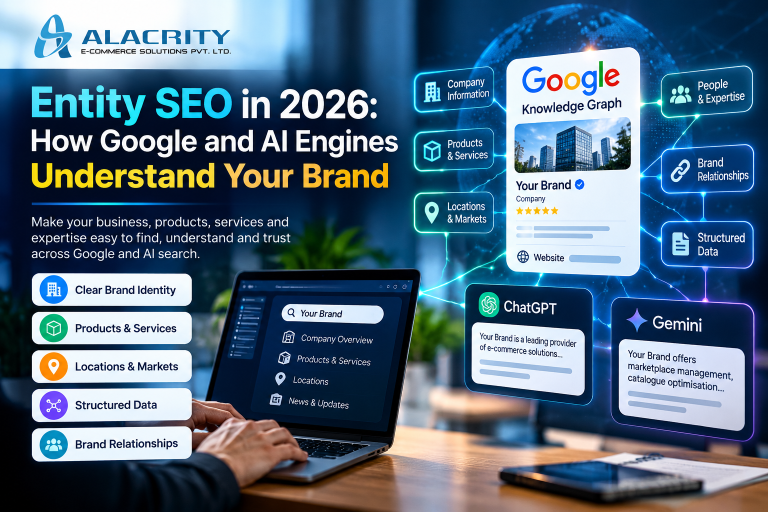
How Google and AI Engines Understand Your Brand
Since the website displays your business in only one way, the old directory continues to show the services which you have discontinued...
Read Article ↗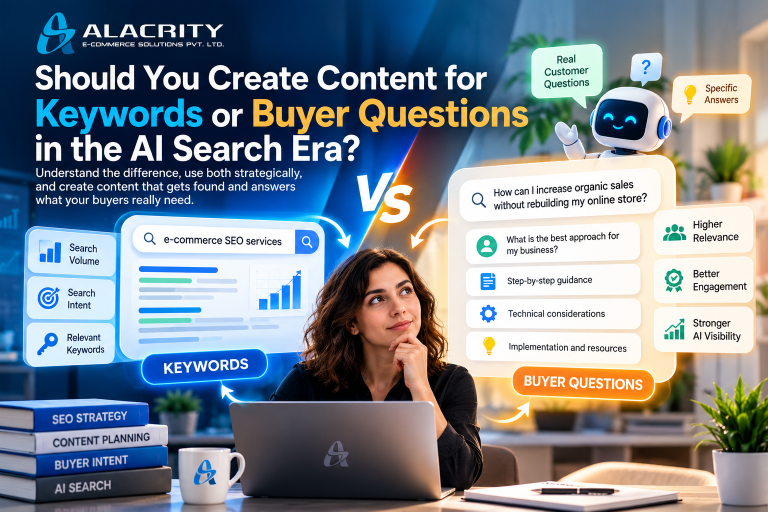
Should You Create Content for Keywords or Buyer Questions in the AI Search Era?
Ensure that the content you produce addresses the questions that buyers would like to know and carry out keyword research in order...
Read Article ↗