
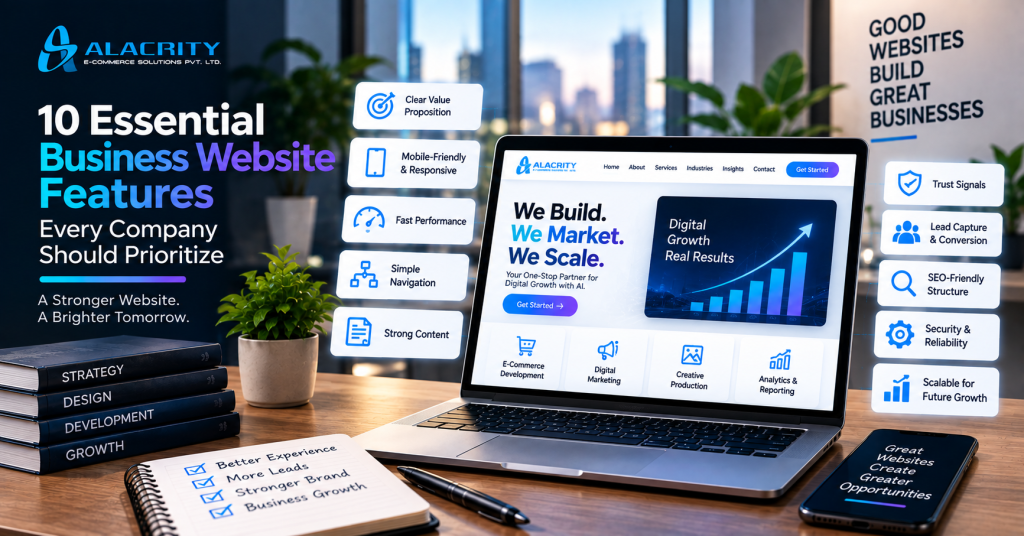
A business website needs to do more than just appear professional; it should enable potential customers to understand what the company has to offer, allow them to find the information that is relevant to them, help them to trust what they see, and enable them to take the proper next step. This makes essential business website features a business priority rather than simply a design checklist.
For B2B companies, the website may support several stages of a buying process. A visitor might discover the company through search, review its services, return later with colleagues, and only then make contact.
The right website features should support this journey without adding unnecessary complexity. Here are ten areas businesses should prioritize.
Clear Value Proposition and Purpose
Anyone visiting the company will soon realize what it does, who it provides services for, and what action they can take next.
A homepage does not need to explain the entire business immediately. It needs enough information to give visitors confidence that they are in the right place.
It is essential for companies offering complex services to give their pages clear headlines, short descriptions, suitable calls to action, and links to the main services in order to establish the context, as the internal terminology which they use might not be easy for a visitor who is looking at the site for the first time to understand.
Responsive Web-design, Mobile-Friendly
The site is responsive, and mobile device friendly. This ensures that no customer should have any problems navigating the website on their phone, tablet, laptop or largest of screens. The customer will neither be forced to zoom in nor zoom out; customers should be expecting to not even have to scroll right or left nor will any buttons be found “too small” as they all work on any screen regardless of shape and size with a very clean design that seems easy to use and navigable.
With regard to page experience guidance from Google, it takes into account whether your page appears on mobile devices correctly as well.
Responsive testing should not consist of nothing more than the general layout; the navigation, buttons, forms, text, images, videos, tables, pop-ups, and the area between interactive elements should all be usable on smaller screens.
Fast and Stable Website Performance
The way a website performs affects the experience of a visitor before they take the time to look closely at the business.
Delays or unstable pages may be caused by having images that are too large, by including scripts which are not necessary, by the presence of plugins, by third-party links, by fonts, by inefficient code, or by a combination of several of these factors.
While Google regards Core Web Vitals when assessing page experience, it also cautions that concentrating on just one signal is not sufficient.
Teams ought to clean up the images, review the tools which no longer provide any real value, check the hosting and caching arrangements, and test the key page templates rather than testing only the homepage.
Simple Navigation and Information Architecture
Visitors should not need to understand a company’s internal structure to find information.
Navigation labels should reflect what customers are likely to look for. Familiar terms such as Services, Solutions, Industries, Resources, About and Contact may be clearer than terminology that is branded.
A clear page hierarchy helps people find what they need quickly. Using page names adding links creating useful footer navigation and keeping menus consistent all support this goal.
This matters a lot for B2B websites. Different people from the company might visit the site with needs. A buyer might be looking for services. A technical evaluator might want implementation details. A senior decision-maker might be checking company credibility. Each person has a reason, for visiting. So making information easy to discover is important.
Navigation should support these different needs without becoming unnecessarily complicated.
Strong Service Pages and Useful Content
A useful service page must explain the problem that the service solves, the people for whom the service is useful, the parts that the service covers, the key capabilities, how the process works and any real dependencies or limits.
Content must answer customer questions instead of repeating promotional claims.
Clear service information also helps search engines see the page. Descriptive headings, logical internal links and specific explanations give context for visitors and, for search engines.
The depth that is needed will vary. A simple service may only need a page while a complex B2B or ecommerce service may need more details before a prospect is ready to contact the company.
Clear Calls to Action and Contact Paths
The action links should match the page and also take into account the visitor’s probable intention; while ‘Contact Us’ might be suitable in certain cases, it does not have to be the only choice.
Depending on their customer journey, the visitors might have to look at the services, ask for information, ask a question, look at some of the related work, send an enquiry or ask for a consultation.
Just as much care should be taken when using contact forms, since requesting too much information causes unnecessary trouble while asking for too little makes it difficult to assess the enquiries.
Also, clear accountability must be taken into consideration. Companies must establish who receives the forms, who reads them, who identifies errors, and what action is taken when there is an inquiry.
Trust, Security, and Accessibility
Trust is set up as the various sections of the website work together.
Factors such as accurate company information, the secure delivery of the website, easy-to-understand policies, clear contact details, genuine examples, responsible claims, and consistent branding all contribute to establishing credibility.
Accessibility should also be incorporated into the basic framework; the W3C’s Web Accessibility Initiative states that web content is considered to be accessible on the basis of principles including being perceivable, operable, understandable, and robust.
Important practical features include meaningful alternative text, keyboard accessibility, clear feedback on forms, readable content, and predictable interactions.
Security goes beyond the use of HTTPS; whether or not businesses need appropriate software updates, access control, backups, protection for forms, and monitoring will vary depending on the type of technology in question and the level of risk involved.
Accessibility and security should not be viewed as aspects that need to be configured only once.
SEO-Ready Structure and Useful Measurement
SEO works better when considered during website planning rather than added after development.
Descriptive page titles, logical headings, clear URLs, useful internal links, crawlable content, relevant image descriptions, and organized service information can create a stronger search foundation.
Content should still be written primarily for the intended audience. Creating pages simply to repeat keywords is not a substitute for clearly explaining the business.
Measurement is just as important. While analytics can enable businesses to understand how visitors find out about and use the website, gathering data without a clear objective may result in dashboards that don’t lead to useful decisions.
The first step for businesses should be to decide what is important, for example qualified enquiries, visits to key service pages, the download of useful resources, or progress made along a relevant customer journey.
When selecting tracking technologies, attention should also be paid to privacy, consent, and the relevant regulatory requirements.
Credible Company Information and Evidence
An About page that provides useful information, correct contact details, relevant information about the team, examples from the portfolio, case studies, testimonials obtained with permission, and suitable industry context will help visitors assess the company.
Evidence must stay genuine and be supported in some way; it is more useful to have a simple example that can be verified than an impressive assertion which cannot be substantiated.
Information that is specific regarding capabilities, industries, and experience is more valuable when it comes to making decisions than general remarks about being innovative or customer-focused.
A Maintainable Website Foundation
A website continues changing after launch. Services are updated, new campaigns are introduced, integrations are added, forms change, employees move roles, and technical requirements evolve.
Businesses need ownership for content updates, backups, software maintenance, form testing, broken links, performance monitoring, integrations and outdated content.
This is the difference between seeing a website as a one-time project and seeing it as a business capability.
Not every improvement has to happen at the time. A company, with mobile layouts should fix usability issues before adding more content. A website that works technically but has weak service pages should focus on better information first. Broken enquiry forms need fixing before any cosmetic changes are made.
Priority should follow customer impact and business risk.
How Alacrity Can Support a Business Website Project
Alacrity E-Commerce Solutions presents website design alongside ecommerce development, digital marketing and SEO, and social media marketing. Its website describes its web design approach around areas including performance, visibility, speed, and user experience.
When companies are thinking of having a new website or are planning a redesign, they can obtain the assistance of a support partner to convert their commercial requirements into practical design and development priorities.
The scope that is suitable will vary according to the audience, the current technology, the business needs, the budget, and the internal resources; businesses must remain responsible for the final requirements, the claims, the approvals, the compliance decisions, and the continued governance of the website.
Conclusion
The most useful essential business website features work together. Clear messaging explains the offer. Responsive design and performance reduce friction. Navigation and service pages support evaluation, while calls to action provide direction. Accessibility, security, and credible company information help build trust.
SEO and measurement are vital for discoverability and ongoing optimization, and a maintainable technical foundation is necessary to protect the website while the business needs are evolving. The ultimate goal isn’t to build in all possible features. The features customers should be targeting are those that provide an advantage for users, truly remove friction, and effectively enable what users need to do on the site.
FAQ‘s
What are the key features of a business website?
Why are essential business website features important for B2B companies?
Does every business website need the same features?
How often should business websites be analyzed?
Does a company need a complete redesign to improve its website?
It needn’t. A review might show that making targeted improvements in navigation, messaging, performance, forms, accessibility, service content, or maintenance is sufficient.
Tagged essential business website features, business website design, B2B website, responsive web design, website performance, website navigation, service pages, website CTA, website security, accessibility, SEO website structure, website maintenance, conversion optimization, web development, Alacrity E-Commerce Solutions