
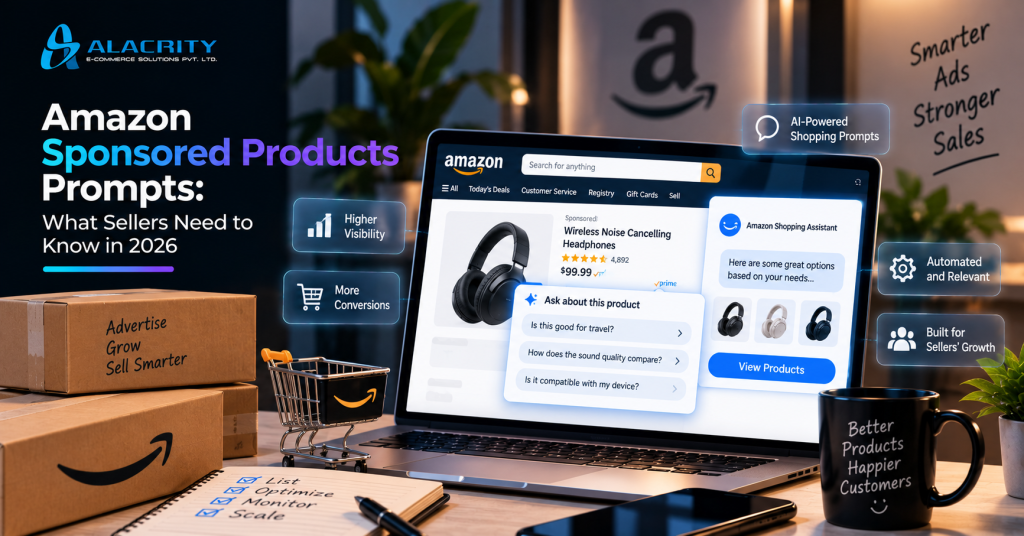
Amazon is now using a more conversational approach when it comes to advertising. This is shown by the fact that Amazon Sponsored Products has arranged for sponsored product information to appear as part of AI-assisted shopping experiences instead of keeping the advertisements in their normal locations, such as during a search or on product pages.
For sellers this is not just another ad format since Amazon is able to create the prompts by means of the information and signals associated with eligible products and campaigns. Sellers have no need to write the prompt copy themselves.
That changes what advertising teams need to monitor. Product information, campaign performance, shopper questions, prompt reporting, and advertising costs now need to be considered together.
What Are Amazon Sponsored Products Prompts?
Amazon’s Sponsored Products campaigns have AI-generated conversational extensions associated with them.
In open beta testing Amazon introduced the Sponsored Products and Sponsored Brands features, and then made them generally available in the United States on March 25, 2026.
Prompts can be seen in the results of shopping searches and on the pages that give details about a product. If a shopper chooses one, Amazon has the possibility of opening a conversation related to the product via its shopping assistant or of giving the answer right where the prompt is displayed.
Sellers do not manually create each question. Amazon says prompts can use brand-provided information, including product detail pages, Brand Stores, and campaign data, together with other Amazon-verified first-party signals.
Amazon also states that prompts go through AI-based moderation and human audits that include fact-checking and the removal of outdated references.
How Amazon Sponsored Products Prompts Work in 2026
Amazon’s current documentation states that eligible new and existing Sponsored Products and Sponsored Brands campaigns in the United States are automatically enrolled in prompts. Sellers do not need to create a separate campaign.
Prompts use existing campaign parameters, including targeting. This reduces setup work, but sellers may see prompt activity even if they did not intentionally launch a separate conversational advertising campaign.
The cost model is also important.
When a shopper clicks a prompt, Amazon applies the existing campaign’s CPC bidding and billing parameters. Prompt clicks use the existing campaign budget, so sellers do not need to establish a separate prompt budget.
This differs from the earlier open-beta period. Sellers reviewing older information about prompts should therefore check publication dates before using it for 2026 campaign or budget decisions.
What Sellers Can and Cannot Control
Amazon controls prompt generation and wording, but sellers still have several ways to influence how the feature is managed.
They can maintain the product and brand information that supports the experience, control their existing campaign budgets, review prompt performance, and pause individual prompts when appropriate.
Amazon allows advertisers to review prompts through Ads Console. Its documented path is Campaigns, campaign, Ad Groups, ad group, Ads, and then Prompts. A prompt appears in this view after it has generated at least one click.
The documentation from Amazon also says that advertisers can get in touch with Amazon if they wish to opt out of the feature.
The key point is to differentiate between having control over the prompt and managing the advertising environment that surrounds it; although sellers cannot determine exactly which prompts Amazon produces, they still have to be responsible for the product information, the campaign economics, their budgets, and their decisions regarding performance.
Product Information Matters in Conversational Shopping
Amazon listings have always required titles, attributes, images, descriptions and other product information. Conversational advertising offers sellers a reason to keep that information complete and up to date.
Amazon says that the questions people ask can come from product pages, brand stores and ads.
A customer might want to find out if a product works for a purpose, what makes it different, from something else if it has a certain material or size or if it needs to work with other items.
An unclear or old listing might not give facts to answer those questions.
Sellers should verify important specifications, remove obsolete information, make meaningful differentiators clear, and check for contradictions across listing elements.
This does not mean adding unsupported claims or excessive keywords to influence prompt generation. Amazon controls how prompts are created and displayed, so changing a listing cannot guarantee a particular prompt or advertising result.
The priority should remain accurate product communication.
Measure Prompt Performance Against Business Results
Prompt-level reporting makes the feature easier to evaluate as part of normal PPC management.
Amazon says advertisers can create a Prompts report through Ads Console. The report can include prompt text, associated ads, impressions, clicks, click-through rate, CPC, spend, sales, ACOS, ROAS, and seven-day orders and units.
No single metric provides the complete picture.
Impressions show exposure, while clicks and CTR indicate whether a prompt attracts attention. CPC and spend show the budget impact. Orders and sales provide more commercial context.
ACOS and ROAS can help evaluate advertising efficiency, but acceptable levels depend on product margins, lifecycle stage, campaign objectives, and the seller’s wider economics.
A prompt generating many clicks is not necessarily valuable if those interactions produce weak commercial results. Sellers should evaluate prompt activity against the objective of the campaign rather than relying on one universal benchmark.
Watch for the Operational Risks of Automation
Automatic prompt generation cuts down on setup but it also brings new monitoring needs.
Outdated product information is a concern. Amazon moderates and audits prompts yet sellers must keep their listings and brand assets accurate.
Another risk is paying for curiosity instead of real buying intent. A conversational question can bring clicks without orders so it is vital to compare engagement, with spend, sales, ACOS and ROAS.
Sellers should not treat every prompt the same. One question could hit a buying concern while another may bring less useful activity. Prompt controls let teams act when data shows it is worth it.
Finally avoid reacting to fluctuations. Advertising data needs time to mature. The right review period depends on traffic volume, sales activity and the product.
Use a Simple Prompt-Management Routine
Sellers do not need a separate advertising operation just for prompts. They do need a consistent review process.
Start by checking whether eligible campaigns are generating prompt activity and review the actual questions shoppers are seeing. These questions may provide useful clues about product features, comparisons, or buying considerations, although they should not automatically be treated as evidence of wider market demand.
Next, connect prompt engagement with commercial results. Compare clicks and spend with orders, sales, ACOS, ROAS, and the campaign’s intended objective.
If a prompt exposes unclear or outdated product information, review the relevant listing. Correct genuine factual gaps or inconsistencies rather than rewriting accurate content simply to chase an assumed AI preference.
When the evidence supports it, individual prompts can be paused. Teams should also document prompt performance, listing changes, campaign adjustments, and review dates so that later results are not attributed to the wrong action.
Understand the U.S. Availability Limitation
Marketplace availability matters.
When Amazon announced in March 2026, it stated that the United States was the market in which Sponsored Products and Sponsored Brands prompts had become generally available. The feature is available to U.S. advertisers on Amazon who use these types of campaigns, except in the case of authors and publishers.
International companies should distinguish between where the business is located and where its Amazon advertising runs.
A company which is headquartered in India, the UK, Singapore, or in another country can still promote its products in the Amazon store in the U.S. It follows that sellers should refer to Amazon’s most up-to-date documentation for the marketplace in which they actually carry out their advertising rather than suppose that the introduction of a feature in the U.S. applies to all regions.
Prepare for More AI-Assisted Shopping
Sponsored prompts also indicate a broader change in product discovery.
Customers increasingly have opportunities to describe problems, ask questions, compare alternatives, and interact conversationally rather than relying entirely on exact search keywords.
Keywords and PPC targeting still matter. What changes is the importance of having useful product information available when shoppers ask more detailed questions.
Sellers should maintain accurate attributes, keep listing information clear, monitor new advertising reports, coordinate PPC and listing teams, and evaluate AI-assisted traffic against real business economics.
The strongest approach is not to automate everything. It is to combine reliable product information and Amazon’s automation with disciplined human oversight.
How Alacrity Can Support Amazon Sellers
Conversational advertising connects marketplace management, product content, and PPC operations.
Alacrity E-Commerce Solutions describes its capabilities across ecommerce, digital development, marketing, content, PPC, Amazon Seller Central Management, and Marketplace Management.
For Amazon sellers, external support can help coordinate campaign reporting, listing reviews, advertising analysis, and PPC activity against commercial objectives.
The seller should still retain responsibility for product accuracy, budgets, account decisions, and business outcomes. Neither an agency nor an AI advertising feature can guarantee profitability.
Conclusion
Amazon’s Sponsored Products service has a conversational feature and, in 2026, eligible U.S. campaigns are automatically enrolled, clicks on the prompts will use the current CPC budgets, advertisers will get reporting at the prompt level, and each individual prompt can be paused.
Seller should ensure product information is accurate. Seller should keep an eye on the questions that are being asked. Seller should associate engagement with orders and advertising economics. Seller should continue to involve judgment in making decisions about campaigns. The way customers find out about products may change. The fundamental principle stays unchanged. That principle is to give information. That principle is to measure outcomes. That principle is to make decisions on the basis of evidence.
FAQ‘s
What are Amazon Sponsored Products prompts?
Amazon Sponsored Products prompts are AI‑powered extensions of Sponsored Products campaigns. Amazon Sponsored Products prompts can provide product information through shopping experiences. Amazon generates Amazon Sponsored Products prompts using signals including product detail pages Brand Stores and campaign data.
Do sellers create prompts manually?
Sellers do not create Amazon Sponsored Products prompts. All U.S. Sponsored Products and Sponsored Brands campaigns that are eligible will be automatically enrolled. Sellers can check the status of their campaigns using the Ads Console and the reporting tools.
Do Amazon Sponsored Products prompts cost money?
Amazon Sponsored Products prompts cost money when a shopper clicks a prompt. In 2026 Amazon Sponsored Products prompt clicks use the existing campaigns CPC bidding and billing parameters and the existing budget.
Can sellers pause prompts?
Sellers can pause Amazon Sponsored Products prompts. Amazon’s current documentation states that advertisers can review and pause Amazon Sponsored Products prompts when appropriate.
What metrics should sellers monitor?
Metrics that Amazon provides for Amazon Sponsored Products prompts consist of impressions, clicks, CTR, CPC, spend, sales, ACOS, ROAS orders and units. Sellers should assess these metrics in relation to product margins and campaign objectives rather than compare them to a general benchmark.
Tagged Amazon Sponsored Products, Amazon Sponsored Products prompts, Amazon Ads 2026, Amazon PPC, Amazon AI advertising, conversational shopping, Sponsored Brands, Amazon Seller Central, Amazon advertising strategy, Amazon PPC management, AI shopping, ACOS, ROAS, ecommerce advertising, marketplace advertising, Alacrity E-Commerce Solutions