
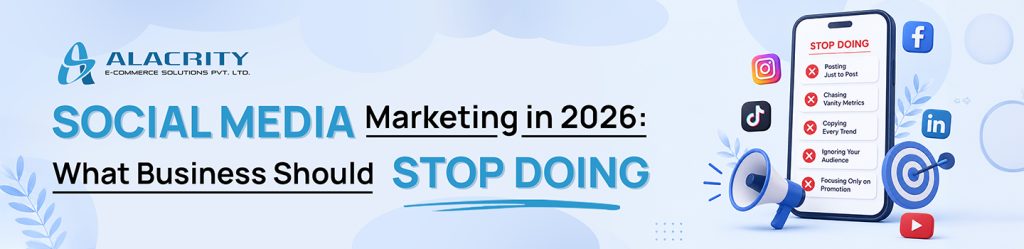
In 2026 social media marketing is shifting from focusing on the quantity of content that a business publishes to concentrating on whether the content merits attention. This is because the platforms have enhanced their methods of recommending content, users have become more selective, and AI has made it easy for almost everyone to produce basic content.
This poses a problem for companies which are still following an outmoded approach. A team can remain occupied by posting every day, by trying to gain followers, by copying trends or by reporting on likes, without thereby demonstrating that social media is bringing about meaningful business value.
A more pertinent question for marketing teams is what activities they should cease carrying out so that their time and resources can be focused on things that have a more definite purpose.
Do not publish merely to keep a publication schedule.
It is still important to be consistent. Being consistent does not mean having a high publishing frequency.
A group that puts out five written posts every week might end up spending more time on creative work, securing approvals and dealing with community management than a group that publishes only two genuinely useful articles; just because more posts are published does not mean that greater business value is achieved.
Rather than first working out how often you are going to post, determine what each piece of content is meant to achieve. For example, a post could be designed to answer a sales question, to explain a product or a process, to educate a potential customer, to support a campaign, to show expertise, or to initiate a helpful conversation.
The content calendar should organize those priorities rather than become the reason content gets published.
Stop Treating Follower Growth as the Main Measure of Success
While follower count can offer some context, it does not indicate to a business whether it is drawing in the correct kind of people.
In the case of a business that sells to other businesses, a smaller audience consisting of customers, prospects, partners, specialists, and people who make decisions might be more commercially useful than a much larger audience who have only a weak connection to the business.
Measurement should therefore start with the purpose of the activity; when the aim is demand generation, teams should consider qualified website traffic, enquiries, conversions, or pipeline influence together with engagement. A different scorecard is needed for brand-awareness activities.
The key thing is that different social media campaigns should not be evaluated using the same metric.
Don’t copy trends unless there is a business reason for doing
Just because a meme, audio clip, format or cultural reference is trending does not mean a brand should jump in.
Trends alone are not enough.
Before joining a trend, businesses should ask:
Does this connect with their audience?
Do they have an angle to bring?
Is this in line with the brand’s values and the level of risk they’re comfortable with?
The goal is not to avoid trends
It’s to be thoughtful. To choose what fits.
Not just follow because others are doing it.
Not just because the reach looks impressive.
It’s about staying true while staying relevant.
Cease publishing AI-generated content without human judgment.
AI generation accelerates brainstorming, authoring, summarizing and repurposing. When speed supersedes good sense, trouble happens.
AI can help teams create topics, organize research, transform pieces into social media posts, write first drafts and handle routine production tasks. These uses are valuable.
The final content still needs a review. A person must decide if it is accurate, sourced, useful, matches the brand, and is truly worth publishing.
In B2B marketing subject‑matter expertise is crucial for credibility. AI can support that expertise. It must not replace the human touch in the final piece.
Don’t use the same content strategy in all situations.
While cross-posting may save time, putting the same message, format, and creative asset out on each platform overlooks the reasons why people use those platforms.
The same basic idea can be put into effect in a different way.
For instance, a business-to-business company could make use of LinkedIn for purposes such as professional development, gaining insights from executives, recruiting, holding discussion sessions based on case studies, or generating demand. The way a consumer brand uses Instagram, on the other hand, will be different since the expectations of its audience and the nature of the content environment differ.
Before deciding which platforms should include a business, it should first clarify the role that each platform plays. It is also easier to manage having a concentrated presence on a smaller number of appropriate platforms rather than keeping up weak activity on all of them.
Don’t turn each of your posts into a sales pitch.
If in almost every posting a request to buy a product, get a quote, arrange a call, or speak to sales is made, the account will soon become predictable.
Social media is also used for educational purposes, for discovery, for professional development, for conversation, for entertainment, and for building a community. A business can meet these needs by providing practical education, giving answers to customer questions, offering useful interpretations of the industry, educating customers about its products, supplying appropriate examples of customer use, presenting expert views, and producing explanatory videos.
Commercial content still has its place; the point is that the company establishes sufficient relevance about it so that a sales-focused call to action becomes reasonable when it appears.
Don’t assume that greater production implies better content.
High production value is important whenever bad execution has an effect on credibility or causes the information to be hard to understand; however, expensive content is not necessarily useful content.
A simple video shown with a well-informed employee is likely to convey a point more effectively than a more elaborate branded video. A basic graphic which clearly sets out a single complicated idea can be more useful than a visually striking one which gives no clear conclusion.
The clarity, credibility, distinctiveness, and suitability of the content for its audience should be the criteria used to evaluate it, not the appearance of its cost.
Do not think of media as a separate marketing activity.
It becomes harder to measure the impact of media when it works alone, disconnected from other marketing efforts.
Social media can be connected to SEO, paid ads, website content, email campaigns, sales support, customer feedback, creative work and overall brand plans.
For example, one expert interview can be turned into an article, social media posts, a short educational video, an email headline, sales material, an FAQ or even the start of a future webinar.
This way of using content is better than making pieces just to fill up social media calendars.
Alacrity E-Commerce Solutions treats media as part of its full set of e-commerce and digital services. These include marketing, SEO, social media marketing, website design, content planning, community management and creative production.
When companies review their media strategy this broader connection helps make sure that social efforts stay in sync with all their other digital activities.
Do not report the metrics without explaining what should be done next.
A report published on a monthly basis, consisting of screenshots, percentage changes, impressions, views, clicks, and increases in the number of followers, might well describe the activity but would not assist the business in making a decision.
A more useful reporting process answers three questions:
1. What occurred? Look at the relevant metrics to identify any significant changes.
2. What could have caused it? Examine the content themes, formats, targeting, distribution, campaign changes, and external factors, without making any claims about causation since the data only shows correlation.
3. What is to be tested next? You should make your decision on content, cadence, targeting, creative, measurement, or spend based on the findings.
When it comes to demand-generation activities, teams should go beyond just surface-level engagement and take into account qualified traffic, enquiries, purchases, pipeline influence, or some other clearly defined business outcome. It is still possible that attribution will be incomplete, especially over the course of longer B2B buying journeys.
In 2026, work on a more focused social media strategy.
Businesses need not alter their social strategy every time a platform changes its algorithm, format, advertising product, AI capability, or policy.
A more effective approach is to act on principles which will still be valid when changes take place, specifically: to understand the audience, to produce original value, to communicate clearly, to compare your performance with clearly defined objectives, and to learn from evidence.
A practical reset could be started by looking over the content from the last three to six months. You should spot any activity that is repeated but adds little value, clarify the purpose of each platform, involve more internal expertise in the process of creating content, set up rules for work that uses AI, and link the metrics to the campaign objectives.
Controlled experiments can be used to identify which activities deserve greater investment. Planning cycles should also involve eliminating activities rather than constantly adding new ones. The outcome should be a smaller number of clearer priorities rather than a longer list of tasks.
Conclusion
The biggest change in social media marketing in 2026 is a move towards greater selectivity.
Companies ought to rethink their approach to publishing based on volume, their emphasis on follower numbers, their indiscriminate pursuit of trends, their use of generic AI-generated content, their identical strategies across platforms, their continuous reliance on sales-oriented messaging, and their reporting which does not aid in making decisions. A better approach is the combination of content, the “real person” element of human experts, and with the platform, audience, and metrics. This best suits your business requirements. Your e-commerce and online sales professionals may want to do more research regarding Alacrity E-Commerce Solutions and what services they attest to offer; including its social media strategies, expertise, e-commerce, and other digital areas.
Frequently Asked Questions
1. Here’s what you should consider: what businesses should stop doing on social media by 2026?
Companies ought to think again about prioritizing volume when posting, about blindly copying trends, about focusing their reporting on the number of followers, about using generic AI-generated content, about publishing the same content on all platforms, about including excessive promotional material, and about relying on metrics that are not linked to their business objectives.
2. Is posting every day?
Not every posting frequency works for everyone. The schedule should match audience expectations, fit the platform context, use the resources you have, and focus on content quality instead of just posting frequency.
3. Should businesses stop using AI for media?
No. Businesses should keep using AI. AI can help with brainstorming ideas, drafting posts, organizing research, creating variations, and reusing content. Human reviewers must still check accuracy, ensure expertise, find sources, keep brand voice, follow rules, and decide on final publishing.
4. Are follower counts still important?
They can provide useful context, but should not be evaluated alone. Audience relevance, meaningful engagement, qualified traffic, enquiries, conversions, and other objective-specific measures provide a broader view of performance.
5. Should a business use every social platform?
We do not think a business should use every social platform. Selecting a platform depends on the target audience a business wants to reach, the business objective a business aims for, the type of content that fits a social platform, and whether the team can do the work consistently on a social platform.
Tagged social media marketing 2026, social media strategy 2026, what businesses should stop doing on social media, social media mistakes, social media marketing tips, social media content strategy, AI generated content social media, business social media strategy, social media trends 2026, social media reporting, follower growth strategy, content marketing, platform specific content, B2B social media marketing, digital marketing strategy, Alacrity E-Commerce Solutions