AI Search
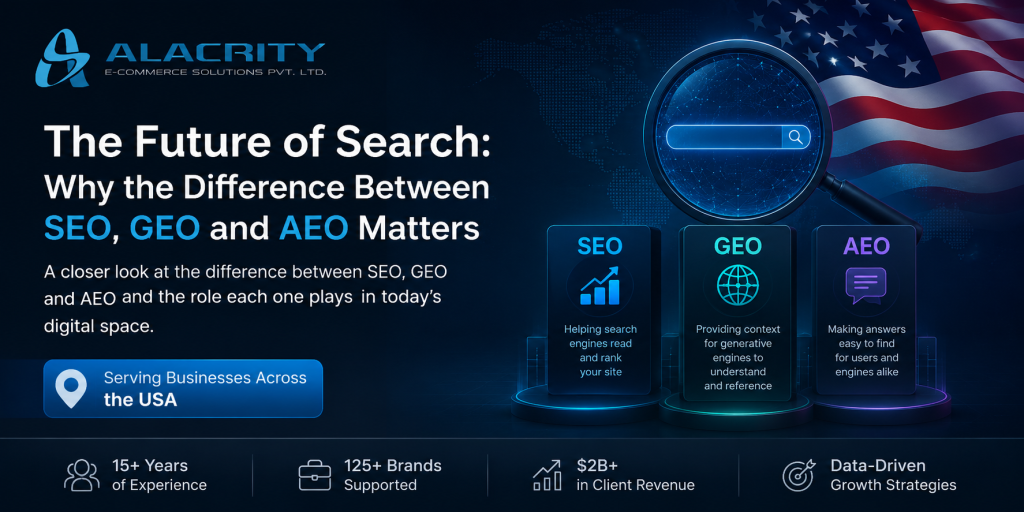
The Future of Search: Why the Difference Between SEO, GEO and AEO Matters
A closer look at the Difference Between SEO, GEO and AEO and the role each one plays in today’s digital space
In this guide
Search. Answers. AI Visibility.
Learn what SEO, AEO, and GEO each focus on, where they overlap, and how to apply all three without creating three separate content plans.



Search now reaches beyond a familiar list of links. In many cases, a user may first see a brief AI summary or continue the search through a chat-style exchange.
SEO, GEO, and AEO do not perform the same job. One supports discovery, another adds context, and the third brings the clearest answer forward.
Key takeaways
- SEO helps relevant pages get found in search.
- AEO makes direct answers easier to identify.
- GEO focuses on how AI responses mention or cite your business.
- Start with accessible pages and useful, verifiable content.
- Track search clicks, brand mentions, and citations separately.
Search Is Becoming a Conversation
Keywords still matter, although users increasingly ask fuller questions and include more context.
Someone may no longer search only for “SEO agency USA.” They might ask, “Which SEO agency can help an ecommerce company appear in Google and AI-generated answers?” That question includes context, intent, and an expected outcome.
Google explains that AI Overviews and AI Mode may use “query fan-out,” where the system runs related searches before preparing a response with supporting links. ChatGPT search can also provide timely answers with links to relevant web sources. AI search marketing is therefore less about repeating one phrase and more about explaining a subject clearly. (Google’s AI search documentation)
Practical principle
Improve one page before building three.
Take a Shopify migration service page. Use SEO to make it easy to find, answer “Can we keep our existing product URLs?” near the top, and include a documented migration example buyers can verify. Each improvement solves a different problem on the same page.
Three Parts of Modern Search
SEO: Helping Search Engines Read the Site
A well-organized website gives search engines fewer obstacles to deal with. The work may include repairing faulty pages, filling in missing details, connecting related subjects, or clearing away anything that frustrates visitors.
SEO remains the foundation of SEO for AI search. Google says its generative Search features are rooted in core ranking and quality systems. A page must be indexed and eligible to appear in Google Search with a snippet before it can be considered as a supporting link in AI Overviews or AI Mode. (Google Search Central)
GEO: Context for Generative Search
Generative Engine Optimization focuses on how content may be discovered, understood, and referenced in AI-generated responses. The term was formally introduced in a 2023 research paper titled “GEO: Generative Engine Optimization.” (Original GEO research paper)
GEO is still an emerging discipline, not a guaranteed ranking formula. Different platforms use different models, retrieval methods, and citation systems.
In practice, GEO means giving a subject enough accurate context to be understood. Specific experience and consistent facts about the business are usually more useful than sweeping statements that cannot be supported.
AEO: Making the Answer Easy to Find
Answer Engine Optimization removes unnecessary searching within a page. A reader should be able to locate the key response quickly and then continue into the supporting explanation.
AEO does not mean reducing every page to short answers. The answer can appear early, with supporting detail close behind.
How SEO, GEO, and AEO Differ
The difference between SEO, GEO and AEO is easier to understand by looking at the job each one performs.
SEO creates the conditions for a page to be found through organic search. GEO concerns the information and context that may be used in a generated response. AEO focuses on making a clear answer visible within the content.
For Google Search, GEO and AEO are not replacements for SEO. Google’s official guidance treats optimization for generative Search as part of the broader search experience and recommends established SEO practices over unsupported AI-specific shortcuts. (Google Search Central)
Bringing the Three Areas Together at Alacrity
At Alacrity Solutions, these areas are handled as parts of the same search strategy. Strong content cannot do much on a poorly maintained website, while technical improvements alone do not give customers a reason to stay.
Work often starts with the questions customers ask before they contact a business. Existing service pages can then be supported with articles, case studies, and FAQs wherever the website leaves those questions unanswered.
Handled well, this protects the organic work already bringing visitors to the site and gives AI search systems clearer information to interpret.
SEARCH. AI VISIBILITY REVIEW.
Is Your Page Hard to Find or Hard to Use?
What Businesses Should Work on in 2026
New AI search tactics should not distract a business from checking whether its current website is doing the basics well.
Core pages should work without technical errors, remain comfortable to read on a phone, and connect visitors with related information. Those pages also need to remain open to search crawlers. Their content should come from the business itself, such as completed work, common customer concerns, lessons learned during projects, or research that others can check.
A heading or FAQ earns its place when it helps a reader find information more quickly. It should not be added simply to make every article follow the same template. Structured data should match the visible page. Google also states that no special AI schema or llms.txt file is required for its generative Search features. (Google Search Central)
This does not mean structured data has lost its value. Appropriate schema can still support standard search features and help search engines interpret information. There is simply no separate type of markup that can secure a place in Google’s AI-generated results.
Search positions are useful, but they do not show the full picture. Enquiries, sales, branded searches, organic visits, engagement, and relevant mentions in AI answers can reveal whether the work is reaching the right people. Better work may improve the chance of visibility, but no business controls which sources a platform decides to use.
What This Means for Businesses
Search is widening rather than leaving conventional SEO behind.
SEO helps a website earn organic visibility. GEO deals with the supporting context that a generative system may draw upon. AEO helps readers and answer engines locate the most relevant response without unnecessary effort.
A sound website, honest expertise, and genuinely helpful content remain the best starting point for organic search and AI visibility.
How Alacrity can help
At Alacrity E-Commerce Solutions Pvt. Ltd., we help businesses connect paid advertising, organic search, content strategy, and conversion optimization.
Our approach focuses on understanding each client’s business objectives and identifying which marketing channels can contribute most effectively.
From PPC campaign management and SEO to AEO, GEO, analytics, and CRO, we work to create coordinated digital strategies rather than disconnected marketing activities.
SEO. AEO. GEO STRATEGY.
Build One Plan for Search and AI Discovery
Alacrity can bring technical SEO, service page improvements, and AI visibility checks into one plan. Focus first on the pages that matter to buyers, then track what changes in search results and AI answers.
Conclusion
SEO, AEO, and GEO give you three ways to look at the same page. Can people find it in search? Can they get a clear answer? Is there reliable information an AI response could reference?
Start with one priority page and one question buyers ask before they inquire. Check that the page is accessible, put the answer where readers expect it, and add evidence where it helps. Measure search performance and AI visibility separately, without assuming either guarantees the other.
ABOUT THE AUTHOR
Alacrity Team
The Alacrity Team shares insights, industry updates, and practical strategies across digital marketing, SEO, e-commerce, paid advertising, and online business growth. Our content is informed by industry research, hands-on experience, and the collective expertise of our digital growth specialists.
Guides
Let's Grow Your Business
- Boost Google & AI Search Visibility
- Drive growth with SEO, AEO, GEO & paid ads
- Scale Sales Across Online Marketplaces
- Build High-Converting Websites & Stores
- Strengthen Brands Through Creative Content
Worth Knowing
Questions worth asking.
GEO is the practice of improving how content may be discovered, understood, or referenced in responses produced by generative search systems.
No. A GEO strategy still relies on the accessibility, relevance, and credibility developed through good SEO work.
GEO deals with context that may support a generated response. AEO makes an answer easier to identify on the page.
Look first at the pages people visit before calling, buying, or sending an enquiry. Confirm that search engines can access those pages and add details drawn from jobs, customers, or day-to-day business experience. Names, services, locations, and contact details should match across the site. The pages that lead to real enquiries or sales usually deserve further attention. Whether an AI platform cites one of those pages is ultimately outside the business’s control.
No. An agency can remove technical barriers, improve the writing, and make a website easier to understand. Google, OpenAI, or the platform producing the answer makes the final choice about which pages appear.
SEO + AEO + GEO
Make One Page Work Harder Across Search and AI
Keep Reading
More ideas that move business forward.
Related thinking across paid media, e-commerce and digital performance.
Can LinkedIn Posts Rank or Get Cited in AI Search?
AI Search Can LinkedIn Posts Rank or Get Cited in AI Search? A Practical B2B Guide Yes, public LinkedIn posts can appear...
Read Article ↗
How B2B Content Can Improve Brand Visibility in ChatGPT and Gemini
AI Search How B2B Content Can Improve Brand Visibility in ChatGPT and Gemini An article that is useful on LinkedIn can be...
Read Article ↗
How Google and AI Engines Understand Your Brand
AI Search How Google and AI Engines Understand Your Brand Since the website displays your business in only one way, the old...
Read Article ↗