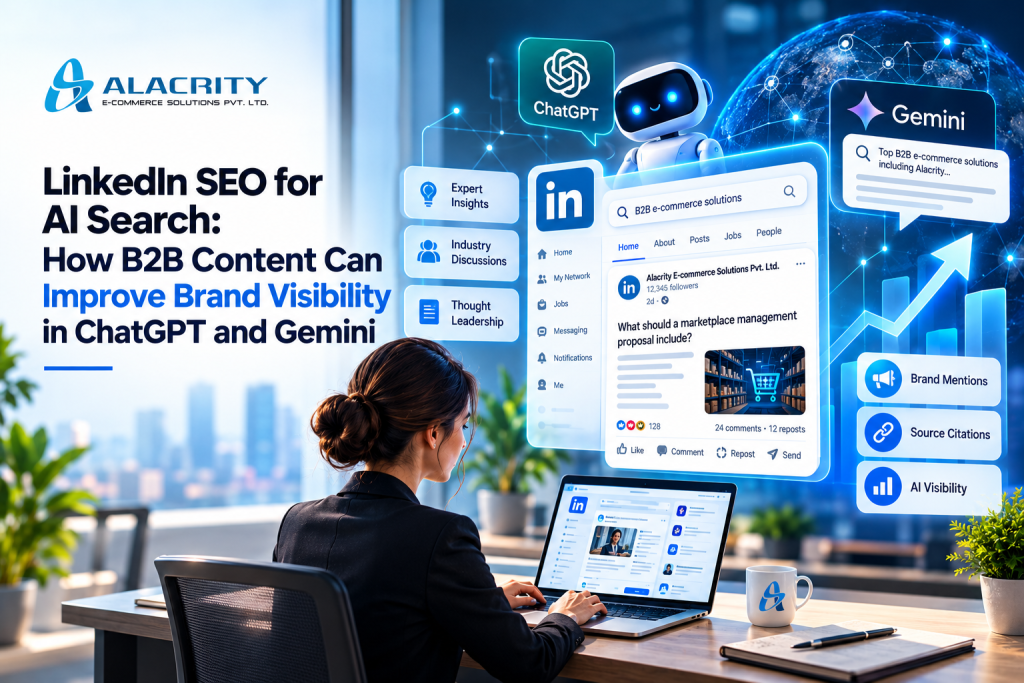
An article that is useful on LinkedIn can be seen by a person who is using an AI tool to research a business question as well as by someone who is simply scrolling through the feed. LinkedIn SEO for AI search involves making your company’s expertise easier to find and understand in this broader context.
The campaign should start off by looking at the real questions that your customers ask. You need to publish the answers which your team can give, link them to solid evidence, and then check how your brand is viewed. Simply putting up more content won’t show you whether the strategy is having the desired effect.
Why does LinkedIn matter for AI visibility?
Meltwater’s May 2026 research examined 9.5 million citations across six AI platforms and 16 B2B categories. In that analysis, 75% of LinkedIn citations came from individual-member content and 25% from Company Pages.
Those figures support including specialists in a B2B content program. They do not mean an employee’s post has a 75% chance of being cited. The study describes citations observed in a particular dataset, not a success rate for everything published on LinkedIn.
There is also a difference between a citation and a recommendation. An AI answer might link to your employee’s explanation without mentioning your company. A brand mention, a source link, and a recommendation should therefore be measured separately.
How can you make your company and experts easier to identify?
A buyer arriving at your Company Page should quickly understand what the business does and whom it serves. Replace vague descriptions such as “transforming digital success” with an accurate explanation of the service and customer problem. Relevant employee profiles should make their roles clear too.
Public access needs attention. LinkedIn’s visibility guidance explains that public profiles are simplified versions of member profiles, and some information may require login. Review the professional details authors want visible, then inspect intended public articles and posts while signed out.
That access check is useful for readers, even though it doesn’t show that an AI crawler can obtain the same content; LinkedIn has control over its own technical access and it can take a while for external search results to reflect changes to a profile.
What should B2B brands publish on LinkedIn to help buyers decide?
“Why choose our agency?” usually produces a sales pitch. “What should a marketplace management proposal include?” gives an operations specialist something useful to explain.
For example, the article could advise buyers to discover who is responsible for changing the catalogue, carrying out the inventory updates, dealing with customer messages, and preparing the reports before they begin to compare the prices. Two of the suggestions may relate to the same price but could still pertain to different duties. The article might be made more detailed by providing a list of the duties together with an explanation of which approvals are still held by the client.
Although the example is hypothetical, the editorial guideline is still useful because it provides value to the reader by calling for both the source and the date to be given each time a statement is based on a platform rule or a research finding, and in the case of any client result, permission is required together with some context and a clear measurement period.
It is suitable to use feed posts when putting forward a particular question or observation, whereas articles are the appropriate choice if you want to include comparisons and explanations of processes. You should choose the format after you have decided what the reader needs; there is no reliable word-count formula for obtaining an AI citation.
To ensure that people can understand the main point shown in a chart or video, the related text should explain it.
How can specialists contribute useful LinkedIn content?
Interview employees about problems they handle, then let them review the draft. An operations manager and a marketing lead will have different things to say about the same customer question. Publishing identical copy through both accounts loses that useful distinction.
It should be made clear which affiliations people have; even though content produced by employees may indicate that they have expertise, this does not constitute an independent endorsement of the employer. The team ought to set up a publishing schedule that they are able to adhere to without compromising the factual review.
How should LinkedIn content connect to your website?
The website needs to provide answers to the questions that are raised in a LinkedIn post; for example, a debate on selecting a provider can illustrate the service details and an approved case study can demonstrate the extent of the work involved in achieving a result. Instead of automatically sending all links to the homepage, direct readers to the appropriate page.
With regard to your own domain, your team will be in a position to look into the technical access issues. According to OpenAI’s crawler documentation, OAI-SearchBot is used for search purposes while GPTBot is the one that crawls content which could be used for model training. OpenAI suggests that OAI-SearchBot and traffic coming from its published IP ranges should be allowed in order to support search visibility.
Request that the website team examine the robots.txt file and the hosting restrictions. Just because access is granted does not mean that a citation will result, and altering your website’s settings will not affect access to LinkedIn. Furthermore, publication does not prove that an article has entered a model’s training data.
How should you measure ChatGPT and Gemini visibility?
Establish a baseline before publishing. One manageable pilot is 20 buyer questions, each run three times per platform during a review cycle. That gives you 60 observations for each platform. Include unbranded discovery questions and branded accuracy checks, but report them separately.
Use fresh conversations and record the date, platform, model label, language, and search settings. For ChatGPT, distinguish search-enabled answers from answers generated without web search. Gemini Apps should also be tracked separately from Google AI Overviews and AI Mode, which are Google Search experiences.
Record four things for every observation:
- Was the brand mentioned, and was the description accurate?
- Did the answer link to your website or an owned LinkedIn page?
- Did that source support the nearby statement?
- Which competing brands or sources appeared?
The number of times the brand is mentioned corresponds to the proportion of completed observations in which the brand is named. The rate obtained from citations in owned sources is the proportion of the observations that include at least one link qualifying as your content. An observation should be counted only once for each of these two measures, even if it has more than one link.
The guidance given by Google for Gemini emphasizes that sources and the related content should be kept separate and it is not the case that every response includes links. When the labels are shown they should be kept and one must not suppose that all of the related links have been used in preparing the answer.
If you compare the later observations with your baseline, you should examine the cases where the brand was not available and then look at the relevant website visits and enquires in those cases; it is worthwhile investigating any increase that occurs after the publication, but you should also consider the possibility that changes to the model, other sources, and the ongoing campaigns could have an effect on the results.
For the first 90 days establish the benchmark, publish on the two primary subjects and then do the checks again. Think of this as a time frame for planning and not as a deadline for the citations.
How can Alacrity support your LinkedIn and website content?
Alacrity E-Commerce Solutions Pvt. Ltd. provides services in digital marketing and SEO, social media marketing, website design, and e-commerce development; these capabilities are relevant whenever LinkedIn publishing has to be coordinated with website improvements.
Take your audience’s questions and those of your regular buyers to a discussion with Alacrity, and before starting the work agree on the content deliverables, check over the responsibilities and go over the reporting.
Where should your LinkedIn SEO for AI search strategy begin?
LinkedIn SEO when it comes to AI search gives B2B teams a valid reason to make their expertise more useful and easier to access. Begin by picking out a small number of questions that buyers might ask, get the people who have the answers involved, and then see what appears on each platform. The observations you make together with the relevant business enquiries should then guide the next round of content.
FAQ‘s
Can LinkedIn content appear in ChatGPT and Gemini answers?
Yes. Citation research has documented LinkedIn content across AI platforms, including ChatGPT and Gemini. A public post can create an opportunity for discovery, but cannot guarantee indexing, citation, or a recommendation.
Should employees or the Company Page publish?
Both can contribute. Use the Company Page for official business information and employees for expertise relevant to their work. Their affiliation should remain clear.
Are articles better than feed posts?
Select articles for in-depth explanations and posts for more specific questions; research samples indicate that there are different combinations of formats, and therefore neither should be considered the best approach for AI visibility.
How long does it take to see results?
There is no dependable schedule; although a preliminary review period of 90 days may be of some help in organizing the task, the outcomes will vary depending on access, relevance, and platform behaviour, together with other factors.
Does LinkedIn SEO replace website SEO?
The website still needs to have accurate service information, some supporting evidence, and a useful next step for visitors, and LinkedIn should too give information about where that expertise can be found; both of the channels in question should be dealt with.
Tagged linkedin seo, ai search, b2b marketing, chatgpt visibility, gemini visibility, linkedin ai visibility, b2b seo, aeo, geo, thought leadership, expert content, ai citations, brand mentions, linkedin content strategy, generative ai search, social media seo, alacrity ecommerce solutions