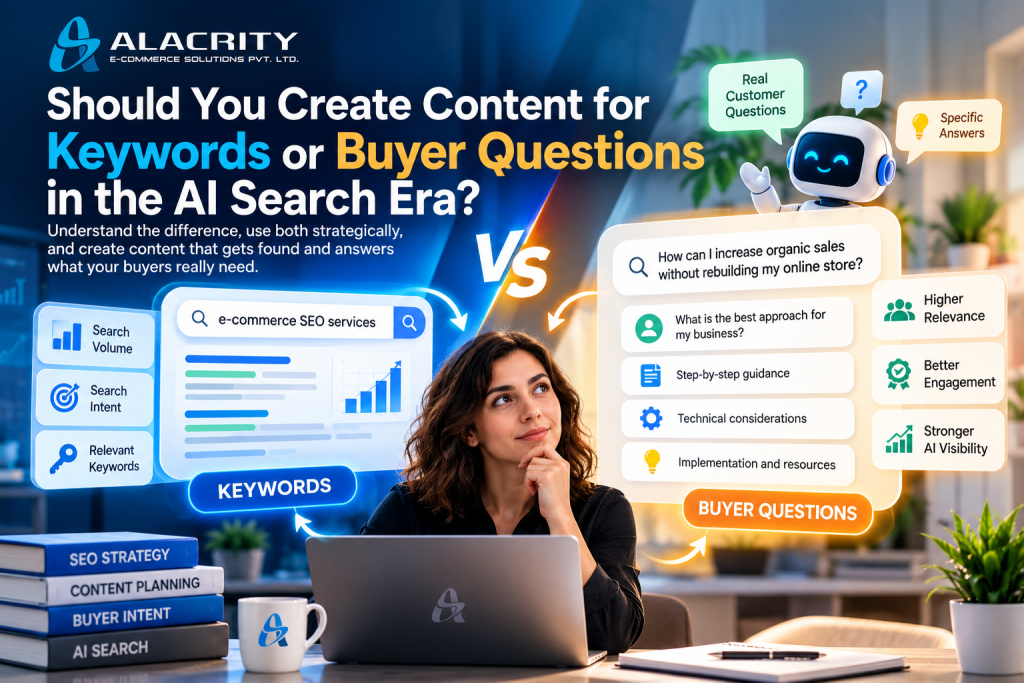
Ensure that the content you produce addresses the questions that buyers would like to know and carry out keyword research in order to see how these needs are reflected in searches. It will be simpler to decide which keywords or buyer questions to select when each of them has a particular role in your content plan.
The term “e-commerce SEO services” may be used to refer to a particular subject but doesn’t indicate what step the reader should take next. Even if one person is concerned about prices and another about the company’s ability to work with their developer, they would still end up seeing the same search results. It therefore follows that a general explanation of SEO won’t meet their individual needs.
The moment on which the search starts is the choice.
Why do buyer questions matter in AI search?
A person who wished to increase organic sales without having to rebuild their online store could have a number of factors to take into account, such as the product content, the navigation, technical issues, and the resources that are available for making changes.
Google describes query fan-out as a technique that allows its AI search features to look into related queries, and the advice it offers on generative AI search also mentions that the fundamental principles of SEO are still relevant.
With regard to content planning, one must go beyond the first phrase and think about the conditions in which an answer is useful. Would the advice be appropriate for a small catalog? Who would be in charge of carrying it out? And in what circumstances would another approach be more suitable?
Those are questions of editorial concern, not a formula for obtaining an AI citation; they assist the writer in determining what the reader actually requires to be explained.
Where does keyword research still help?
Keyword research enables you to identify the language that buyers use and to examine the intent behind it; although “SEO agency pricing” and “how to do SEO” refer to the same general topic they require different pages.
The SEO Starter Guide from Google states that you need to consider the search terms that readers use, as its system is capable of matching relevant pages even if the exact phrase is not included in the text.
You should carry out further research on keywords, look at the pages that come up as a result of that research, compare the purpose of those pages with that of your own product or service, and at the same time check whether customers use similar language. Even if your decisions are based on search volume, the fact that search volume alone should not be what determines them. A question which prevents you from making a recommendation must still be taken into account even if the tools indicate that the exact phrase has only a small amount of demand.
How can you turn customer questions into a useful content plan?
A suitable place to start is by looking at sales conversations. In addition, information can also be obtained from proposal feedback, support tickets, website searches, and interviews—information which a keyword export fails to capture. We need to use the precise words which the buyer used in that situation, and for that we must find out who asked the question, what was the subject of the assessment, and why the answer was important.
Which questions belong together?
The questions that lead to the same conclusion should be put together; for example, information about fees, the deliverables and the exclusions could all be put on a single page to explain the scope of the service, while a question concerning the technical setup would have to be given its own guide since the reader needs instructions rather than an overview.
Before writing a new article, it is necessary to look over the existing coverage. If the onboarding section of a service page is unclear, then make improvements to that page. Minor differences in the wording are usually not a good enough reason for having several pages with almost identical answers.
What should a writer’s brief contain?
Give the writer enough information to answer accurately:
- The buyer’s main question and the decision it affects.
- Relevant search terms and the page being created or updated.
- Evidence available, including details still awaiting confirmation.
- A person responsible for checking the answer.
- The next step the page should help the reader take.
It is essential to concentrate on the questions that your business is able to answer. If no evidence is available, then get an expert to carry out a review or reduce the scope of the claim. You must never use a plausible guess to fill in any missing information regarding cost or performance.
What would this look like for an e-commerce business?
Let us suppose that a retailer is assessing an SEO partner. This is not based on a actual client case study but rather a hypothetical example.
The keyword in question is “e-commerce SEO services”, but the buyer’s real concern is this: “What will the agency do and what will our team then still have to do?”
An effective services page should make it clear who is responsible for various tasks; for example, it could state who prepares the recommendations, who approves the content, and whether development work is covered. If the retailer is required to provide a developer, this should be mentioned before the inquiry form.
Readers can be directed to a preparation guide which includes information on access and the product. It is not necessary to put all the implementation details on the service page, but the transfer of responsibility should be clear.
The buyer now has some stuff to assess, but it hasn’t yet been determined whether this results in a higher number of inquiries.
How should you write answers people can trust?
The answer should be given at the start and then details should be provided concerning what the reporting includes and how it is reviewed, since these details do in fact reflect the service offered.
It is helpful to include question headings as this makes it easier to find the information; yet they can’t make up for an answer which does not deal with the difficult details. Generally, the amount of explanation needed about costs, limitations, compatibility and responsibilities is more than that which is needed for the benefits.
Google states that it is not necessary to break the content down into very small parts or to follow a particular AI writing style; instead, the depth of the answer should be based on the subject matter. A brief answer will suffice for a simple question, while a more complicated comparison will require room for qualifications.
Technical access also matters. For Google, check indexing, snippet eligibility, and the Search generative AI inclusion control in Search Console. Meeting eligibility conditions does not guarantee selection, and Google’s requirements should not be presented as universal rules for every assistant.
How will you know whether the content is working?
Measure visibility separately from business results. Google’s generative AI performance reports provide dedicated impression reporting with views such as pages and countries. Microsoft has also introduced citation and grounding visibility through Bing Webmaster Tools.
Those observations need context. Review what visitors do on relevant pages and whether inquiries fit your services. Sales feedback can help establish whether the content answers concerns that previously required explanation.
For manual AI checks, record the question, platform, date, and cited URLs. Repeat the checks before drawing conclusions. One appearance is a useful observation, but it cannot establish consistent visibility or prove that the content generated revenue.
How can Alacrity help connect content with buyer needs?
Alacrity E-Commerce Solutions provides digital marketing and SEO, content solutions, website design, and e-commerce development; these capabilities are appropriate in a situation where improving an answer involves changes to both the copy and the website.
A practical initial brief should consist of a series of questions that customers frequently ask together with the pages designed to answer those questions; you should then take this brief to a conversation with Alacrity in order to go over the gaps, the amount of work involved, and the way in which progress is to be measured.
What should guide your next content decision?
Choose a key page and then compare it with the information that potential customers provide before they decide to make a purchase. Find any concerns which are not dealt with, check the facts, and improve the company’s response prior to carrying forward the publishing schedule. When choosing between using keywords and responding to buyer questions, you should end up with a more effective brief. Keywords enable you to grasp the demand, while buyer questions indicate which points need to be explained. As a result, your team will have a practical basis for deciding which items to publish and which to improve.
FAQ‘s
Should every heading be a question?
Only when that wording helps the reader. Question headings suit common concerns; descriptive headings may work better for steps or specifications. Neither format guarantees inclusion in AI answers.
Does each keyword need a separate article?
It is possible on one page to include several keywords which are related and relate to the same task; but if there is a substantial change in intent or in the required depth then a separate page should be made.
What if a buyer question has little reported search volume?
It must be checked to see whether or not it occurs in real conversations between customers and agents; even if it affects the customers’ decision to buy, a response should still be provided, usually on the same page.
Can existing content be updated instead of replaced?
It is by no means necessary to retain the useful information and attend to the specific gaps, for in the event that the scope of the services had not been clearly explained it would have been necessary to include a few verified details instead of carrying out a full rewrite.
How soon should results be reviewed?
Choose a review period that matches your traffic and sales cycle; initially focus on discovery and engagement and only afterwards evaluate potential inquiries once you have gathered sufficient evidence. Avoid judging the strategy based on a short-term increase in traffic.
Tagged keywords vs buyer questions, ai search, content strategy, keyword research, buyer intent, aeo, geo, seo, conversational search, ai search optimization, content planning, search intent, customer questions, generative ai search, ecommerce seo, alacrity ecommerce solutions