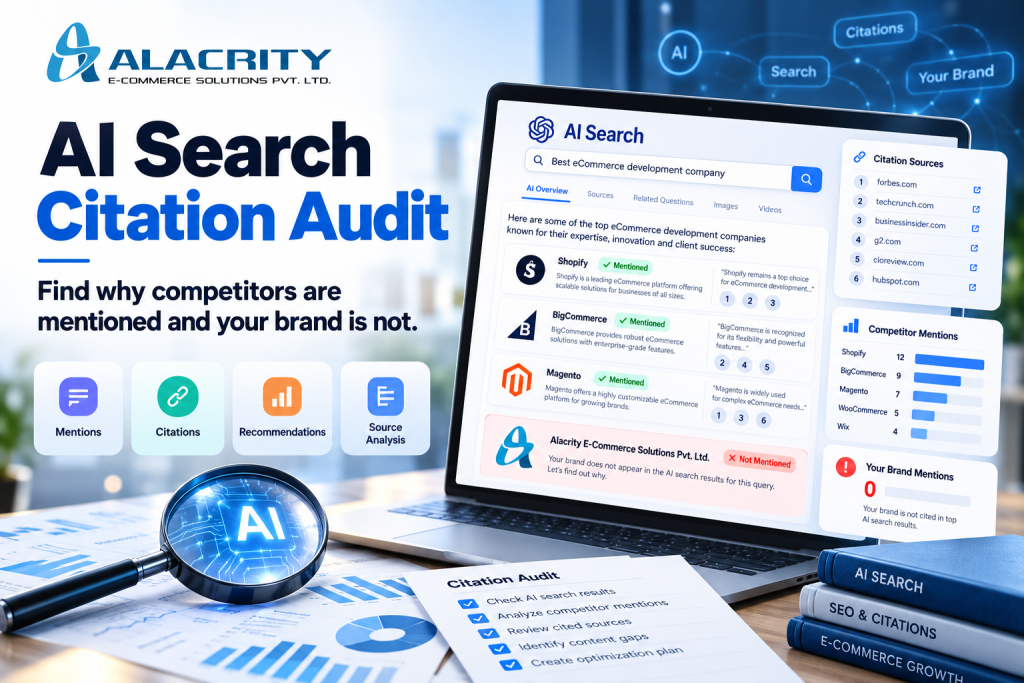
An AI answer cites three competitors. Your business provides the same service and is completely absent from that list. Before you go ahead and publish any more content, take a look at the question and the evidence in that answer.
An AI search citation audit looks at the brand mentions, the recommendations and the source of those in relation to the relevant buyer questions. It’s all about identifying any missing information, access issues and incorrect descriptions that are worth looking at. The outcome should be a sensible list of actions, with enough evidence to support why each one is an action that needs to be taken.
What should your audit measure?
A mention means the answer names your brand. A citation links to a source, which might be your website or an independent publisher. A recommendation goes further by presenting your business as suitable for the buyer’s needs.
Record those separately. Your guide could be cited without your company being on the recommendation list at all, whereas a competitor could be on a shortlist which was backed up by a third-party comparison.
Read the surrounding text as well. A warning about your product is still a mention, just not the outcome you’d necessarily want from your marketing team.
Which questions will reveal a useful competitor gap?
Select questions from sales enquiries, customer conversations and the decisions that the buyer makes prior to even contacting a supplier. For an e-commerce services business that could be:
- Which agencies manage Amazon and Walmart operations for US homeware brands?
- What should a retailer check before outsourcing marketplace account management?
- Which partners provide catalogue management and paid advertising support?
These are just sample examples, not actual measured search volume data. Adapt them to the services you’re actually providing.
Separate unbranded discovery questions from questions which name your company. ‘What does Alacrity do?’ is a recognition question. ‘Which of the following companies can solve X problem?’ is a question which is testing whether it gets into the consideration set.
Pick a few relevant competitors and note the others that keep reappearing. Split out the directories and publishers as a distinct category as they may be the ones providing the evidence rather than the ones actually competing for the same customer.
How do you build a baseline you can trust?
A manageable pilot could use 15 questions across three AI surfaces with three runs on separate occasions. That gives you 135 observations. It’s a working sample, not a statistically representative view of every buyer.
Use fresh conversations and record the exact prompt, date, language, market, account state, personalization settings (if any) and model/mode (if visible). Save the full answer and the source URLs. Note whether a search was used.
Keep Google AI Mode, AI Overviews and the Gemini app completely separate. Likewise an answer obtained via an API should be marked as such rather than be assumed to be a replication of the consumer interface.
Record ‘no AI answer’ where there’s no Overview and differentiate that from a failed request. Keep the original prompt verbatim for retests and put new questions in a separate group.
What do the cited pages tell you?
Open each important citation and find the passage supporting the answer. Does it describe a capability, provide an example, or compare suppliers? Does it actually support the claim made about the competitor?
Suppose a cited case study explains a competitor’s reporting cadence and shows sample outputs. Your equivalent page promises only “data-driven reporting.” There is a concrete information gap to investigate. If your team offers comparable reporting, explain the process and publish an approved example.
That does not prove the case study caused the recommendation. It gives you a supported improvement to test.
Occasionally the competitor will just tick a box that you haven’t. The content should be describing the actual service. Be very aware of the potential for confusion between similarly named companies, out of date locations and out of date product information on the third-party sites.
Could technical settings be limiting visibility?
Ask your technical team to look at the relevant pages prior to replacing them. Check indexability, canonicals, internal linking, response status and access to the actual content. Check CDN and firewall rules as well as robots.txt (an allowed crawler can still be blocked).
Google’s current guidance is that pages need to be indexed and snippet eligible and the site needs to be included in Search generative AI via Search Console. The site owner should verify that setting. Eligibility does not necessarily mean that the site will be included in a particular answer.
For the ChatGPT search function OpenAI have OAI-SearchBot and GPTBot. OAI-Searchbot is the one that does the search. GPTbot is the one that collects content for training. Their controls are separate so you can look at the search crawler access and the published IP ranges without assuming that simply changing your training preference will resolve the issue.
Perplexity identifies PerplexityBot as their search crawler and recommend that you allow it along with its published IP ranges. Look at each platform in turn. A simulated user-agent request is merely a first check and doesn’t in any way prove that the actual crawler has in fact reached your content.
How should you prioritize fixes?
For each finding that you have, record the question it relates to, the evidence that it’s a finding, the proposed change, the effort involved and the retest condition. Assign the work to someone who can do it.
Confirmed access failures and inaccurate public facts deserve early attention. Next, address commercially important questions where your business has useful evidence that is missing from the website.
When an independent comparison appears repeatedly, check the inclusion criteria. An evidence based correction or a submission via the publisher’s normal process may be the right thing to do. Buying fake reviews and just flooding the site with mentions will not in any way constitute valid evidence of your ability.
Which results show progress?
Track the mention rate, the owned site citation rate and the recommendation rate separately. For each of those, take the number of valid answers which contain that outcome and divide it by the total number of valid answers in the same test group. Count each outcome only once per answer and show the raw numbers as well as the percentages.
For AI Overviews, report how often an Overview appeared across successful searches as well. Keep searches without an Overview and failed requests visible rather than quietly dropping them from reporting.
Bing’s Topics Portfolio beta can provide additional evidence when sufficient site data exists. It groups grounding queries into themes and highlights opportunities where other sites appear. Its coverage should not be treated as a view of every AI platform.
Compare like for like question groups and markets. Referral visits and qualified enquiries would fall in the same bracket as the visibility figures, a citation in itself of course doesn’t prove that a visit or a purchase has actually occurred.
How can Alacrity help turn findings into action?
Alacrity E-Commerce Solutions cover the full spectrum of digital marketing (SEO, content, etc), as well as website design and e-commerce development. All of that is relevant if an audit has identified service pages that need work or technical work that needs looking at.
Bring the captured answers and cited URLs to the discussion so the team can agree on specific changes and how to assess them.
Where should you start?
Start with one service category and the actual questions that are driving the purchase decision. Check the sources, work out the key gaps and leave the baseline where it is. An AI search citation audit should leave your team with a very clear idea of what to fix and what still needs to be proven.
FAQ‘s
Can you run an AI citation audit without paid tools?
A spreadsheet and the saved responses will be sufficient for a small pilot. Paid tools can be of help when you get to the stage where repeat collection or multiple markets are difficult to manage, though you’ll still need to check their sampling methods.
Why might a lower-ranking competitor be cited?
Google describes query fan-out, where related searches contribute to an answer. A cited page may address a sub question your ranking report does not cover. Inspect its relevance to the actual answer.
Can your brand appear without a link to your website?
Yes, the answer could name your company and reference a third party. That third party reference would have to be recorded separately from a reference on your own site and you’d have to verify that the source actually makes the claim.
When should you repeat the audit?
Check implementation promptly, then rerun the same questions consistently. Monthly reviews are a practical starting point, with earlier checks for factual corrections or access repairs. There is no universal improvement deadline.
Can an audit prove why your brand was excluded?
It can reveal observable gaps and test out plausible explanations. The internal selection decisions are still to a large extent unknown so one changed answer won’t be sufficient to establish that a particular edit was the cause of the improvement.
Tagged ai search citation audit, ai citations, competitor analysis, ai search visibility, brand mentions, ai recommendations, aeo, geo, generative ai search, chatgpt citations, google ai mode, ai overviews, perplexity citations, competitor mentions, technical seo, citation tracking, alacrity ecommerce solutions